
Mobile & Embedded IoT · 2026-09-12
Final Year App Development Projects with Hardware and IoT.
Selecting viable final year project ideas in Pakistan that integrate cross-platform mobile apps with physical microcontrollers is one of the highest scoring choices for computer systems engineering. Building a working fyp prototype connected via BLE, MQTT, or Wi-Fi demonstrates both frontend UX mastery and embedded hardware competence.
Discover how computing and software students build high-scoring mobile applications that interface with physical microcontrollers, Bluetooth sensors, and real-time cloud telemetry dashboards.
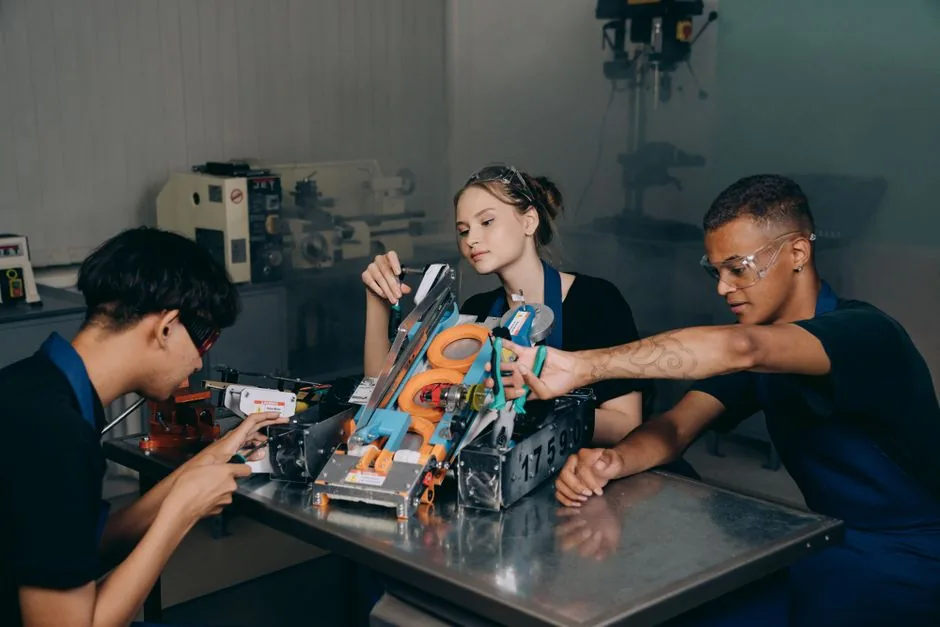
The most successful app development projects for final year students combine intuitive cross-platform mobile interfaces with physical embedded hardware, edge microcontrollers, and real-time cloud pipelines. In Pakistani universities such as FAST-NUCES, NUST, COMSATS, UET, and Punjab University, pure standalone software applications without hardware interaction or complex algorithmic logic often receive lower marks from engineering and computing evaluation committees. If you want an outstanding grade, build an app that communicates with physical sensors, controls real-world actuators over Bluetooth Low Energy (BLE) or MQTT, and delivers actionable telemetry dashboards. Discover how PakMEC accelerates your build through our FYP design and development in Pakistan services.
Why Standalone Mobile Apps Often Receive Lower FYP Grades
Academic capstone committees require students to demonstrate engineering problem solving, system architecture design, and real-world deployment challenges. When students submit standard mobile apps, such as a food delivery clone, e-ticketing system, or basic social media feed, evaluators recognize that these applications merely replicate standardized templates without introducing novel engineering contributions.
By contrast, an application that connects directly to custom hardware, such as an agricultural telemetry hub, a patient vitals monitor, or an industrial automation gateway, demonstrates hardware-software integration, real-time asynchronous communication, protocol handling, and error recovery. This cross-disciplinary approach satisfies both Computer Science (CS) and Software Engineering (SE) evaluation rubrics.
The Real Technical Challenges Evaluators Test in App Viva Defenses
During your final project defense, examiners will scrutinize how your mobile application handles edge-case scenarios: What happens when packet loss occurs over cellular networks? How does your app parse raw binary sensor packets without lagging the main UI rendering thread? Does your background Bluetooth service drain excessive smartphone battery? Addressing these system-level constraints transforms a simple app into an engineering triumph.
Top Hardware-Interfaced Final Year Project App Ideas
The highest-scoring app projects solve urgent challenges in healthcare, industrial safety, and smart agriculture in Pakistan. Below are four high-impact application project architectures.
| Application Domain | Mobile Stack | Embedded Node | Network Protocol | Telemetry Rate |
|---|---|---|---|---|
| Agri-Soil Telemetry | Flutter + Riverpod | ESP32 + LoRaWAN | MQTT over Cellular | Every 30 seconds |
| Cardiac ECG Monitor | Flutter Custom Canvas | nRF52840 / ESP32 | BLE 5.0 GATT Notify | 250 samples / sec |
| Vibration Diagnostic | React Native + WebSockets | STM32 + ADXL345 | Direct BLE Stream | 1 kHz raw burst |
| EV Battery Dashboard | Flutter + Hive DB | ESP32 CAN Bus Node | MQTT + Local BLE | Every 250 ms |
1. Smart Agricultural Telemetry and Automated Irrigation App
Build a cross-platform mobile application that provides Pakistani farmers with real-time field intelligence. The app communicates with distributed solar-powered field nodes featuring soil moisture sensors, temperature probes, and nitrogen-phosphorus-potassium (NPK) sensors, allowing automated and manual water pump switching.
- Application Tech Stack: Flutter framework for cross-platform UI, Riverpod for state management, and Hive for fast local offline caching.
- Hardware and Cloud Pipeline: Field nodes powered by ESP32 microcontrollers transmitting sensor packets over LoRaWAN or cellular GPRS to an EMQX MQTT broker.
- Key Features: Interactive soil hydration maps, automated watering schedules based on localized weather forecast APIs, and Urdu language voice guidance.
2. Telemedicine Remote Patient Monitoring and ECG Telemetry App
Address healthcare accessibility in remote areas by engineering a portable patient monitoring app. A wearable chest strap with an AD8232 ECG sensor and MAX30102 pulse oximeter streams biometric data via Bluetooth Low Energy (BLE) to the smartphone.
- Real-Time Graphing: Custom Canvas rendering in Flutter plotting live electrocardiogram (ECG) waveforms at 250 samples per second with zero UI stutter.
- Automated Anomaly Detection: On-device algorithms calculating heart rate variability (HRV) and triggering automatic emergency SMS alerts with GPS location via SIM800L when cardiac arrhythmia is detected.
3. Industrial Machinery Vibration Monitoring and Predictive Maintenance App
Develop an industrial diagnostic application that interfaces with tri-axial MEMS accelerometers mounted on industrial electric motors. The mobile app reads vibration spectra over BLE, calculates Fast Fourier Transforms (FFT), and flags bearing wear or rotor misalignment before catastrophic mechanical failure occurs.
- Communication Architecture: Custom BLE GATT service with dedicated UUIDs for raw acceleration data and battery telemetry.
- Data Analytics: Frequency-domain peak detection algorithms comparing live motor vibration against ISO 10816 mechanical vibration standards.
4. Smart Electric Vehicle Fleet Telemetry and Battery Health App
Create a companion dashboard for electric scooters or rickshaws in Pakistan. The application connects to an onboard Battery Management System (BMS) over Bluetooth or cellular IoT, displaying real-time cell balancing, motor temperature, regenerative braking efficiency, and remaining range estimates.
Architecture Breakdown: Connecting Mobile Apps to Embedded Hardware
A professional hardware-connected mobile application relies on three foundational architectural layers:
1. The Embedded Firmware Layer (ESP32 / STM32)
The microcontroller acts as the physical sensor hub. It samples analog sensor voltages, formats the readings into compact JSON strings or binary byte arrays, and broadcasts them via Bluetooth Low Energy (BLE) GATT characteristics or Wi-Fi sockets.
2. The Transport Protocol Layer: BLE vs. MQTT
Choosing the right communication protocol depends on physical operating distance:
- Bluetooth Low Energy (BLE 5.0): Best for direct short-range pairing under 20 meters. It requires zero internet infrastructure, provides near-instantaneous packet transmission, and consumes minimal smartphone battery.
- MQTT (Message Queuing Telemetry Transport): Optimal for long-range cloud-connected systems. Its lightweight publish-subscribe architecture operates smoothly over unstable cellular networks in Pakistan, using minimal data bandwidth.
3. The Presentation and State Management Layer (Flutter / React Native)
The mobile app must isolate hardware communication streams from the user interface. In our prototyping lab testing, executing Bluetooth packet parsing inside background isolate threads ensures the main UI thread maintains a butter-smooth 60 frames per second rendering rate, even while processing dozens of live sensor updates every second.
Step-by-Step Viva Preparation for App Development Students
When presenting your application project to university external examiners, execute these critical preparation steps:
- Prepare a Standalone Offline Demonstration: Never rely on university Wi-Fi during your viva defense. University networks frequently block custom MQTT ports or suffer bandwidth bottlenecks. Always configure your smartphone as a local Wi-Fi hotspot, or demonstrate direct Bluetooth Low Energy connectivity.
- Document Data Flow and Architecture: Include complete UML Sequence Diagrams and Component Architecture charts in your slide deck, illustrating exactly how a sensor reading travels from the physical transducer to the mobile UI widget.
- Present Benchmark Performance Logs: Document battery consumption percentages, memory allocation footprints, packet drop rates, and end-to-end latency in milliseconds to prove system efficiency.
Need parts made for your project? PakMEC's FYP development support covers CAD, PCB design, 3D printing and fabrication, while the engineering decisions stay with your team.
Frequently Asked Questions
Is Flutter better than React Native for hardware-connected final year projects?
Flutter is generally superior for hardware-interfaced engineering projects due to its direct compilation to native ARM machine code and mature Bluetooth Low Energy plugins (such as flutter_blue_plus). Its high-performance rendering engine handles live real-time sensor graphing without JavaScript bridge bottlenecks.
How can we demonstrate our app if hardware connectivity fails during the viva?
Always incorporate a mock data simulator toggle switch inside your mobile application settings. If an external battery runs out or a hardware sensor wire snaps during transportation to the defense room, activating mock simulation mode allows you to demonstrate full UI workflows, database storage, and cloud syncing without panic.
Can Software Engineering students build hardware prototypes for their FYP?
Yes. Multidisciplinary capstones combining software and physical hardware are celebrated by university accreditation bodies across Pakistan. Software engineering students frequently handle system architecture, mobile companion apps, and cloud backend microservices, while partnering with hardware prototyping specialists for PCB fabrication and mechanical housing.
Need help with the next step?
Need Physical Hardware to Pair with Your Mobile FYP App?
PakMEC provides embedded microcontroller programming, BLE GATT development, custom PCB fabrication, and cloud telemetry integration for mobile app capstone projects.